Written byLucienUpdated on Sep 21, 2026

Before we start: exFAT is the top recommendation for cross-platform external drives, supporting both full read/write access on macOS and Windows with no individual file size limits. FAT32 offers universal compatibility across older devices, consoles, and operating systems, but restricts individual file transfers to 4GB. NTFS is Windows' native file system featuring advanced journal security; macOS natively provides read-only support for NTFS unless enabled via third-party tools like Donemax NTFS for Mac.
PAGE CONTENT:
Whenever you plug a new external hard drive, SSD, or USB flash drive into your Mac, you are faced with an essential decision: how should you format it?
Choosing the wrong file system can lead to unexpected headaches—such as being unable to copy a large 4K movie file, finding your drive stuck in 'read-only' mode on macOS, or discovering that your smart TV cannot read your drive at all.
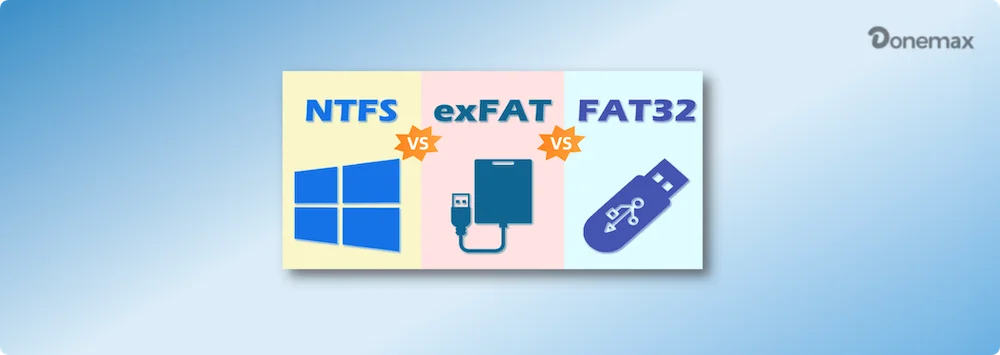
In this guide, we will break down the comparison of exFAT vs FAT32 vs NTFS in simple, plain language. We will explore how these file systems behave on macOS, highlight their key differences, and help you choose the best file system for your hard drive or USB drive.
Think of a file system as the digital librarian of your storage drive. Without a file system, a hard drive or flash drive is just a blank heap of magnetic or electronic storage with no way of knowing where one file ends and another begins.
The file system organizes your files into folders, assigns file names, records creation dates, and manages indexing so your operating system can locate your data in milliseconds.
Because Apple's macOS and Microsoft's Windows were built on different software architectures, they handle file systems differently. When you connect an external storage device to a Mac, macOS checks the file system structure to determine whether it can read files, save new data, or edit existing documents.
Introduced by Microsoft back in 1996 with Windows 95, FAT32 is one of the oldest and most widely supported file systems in digital computing today.
Launched in 2006, exFAT was created as the modern successor to FAT32. It eliminates the restrictive 4GB file size limit while retaining cross-platform functionality.
NTFS is Microsoft's proprietary, modern file system used as the primary internal format for Windows operating systems. It incorporates advanced journal security, permissions, and compression features.
Feature |
FAT32 |
exFAT |
NTFS |
|---|---|---|---|
Mac Compatibility |
Full Read & Write |
Full Read & Write |
Read-Only (Without 3rd-party tool) |
Windows Compatibility |
Full Read & Write |
Full Read & Write |
Full Read & Write |
Max File Size |
4 GB limit |
16 Exabytes (No practical limit) |
16 Terabytes (No practical limit) |
Journaling / Security |
No |
No |
Yes (High data security) |
Ideal Use Case |
Old devices & small USBs |
Mac & PC external drives/SSDs |
Windows primary drives |
To choose the right file system for your hard drive or external device, ask yourself these three straightforward questions:
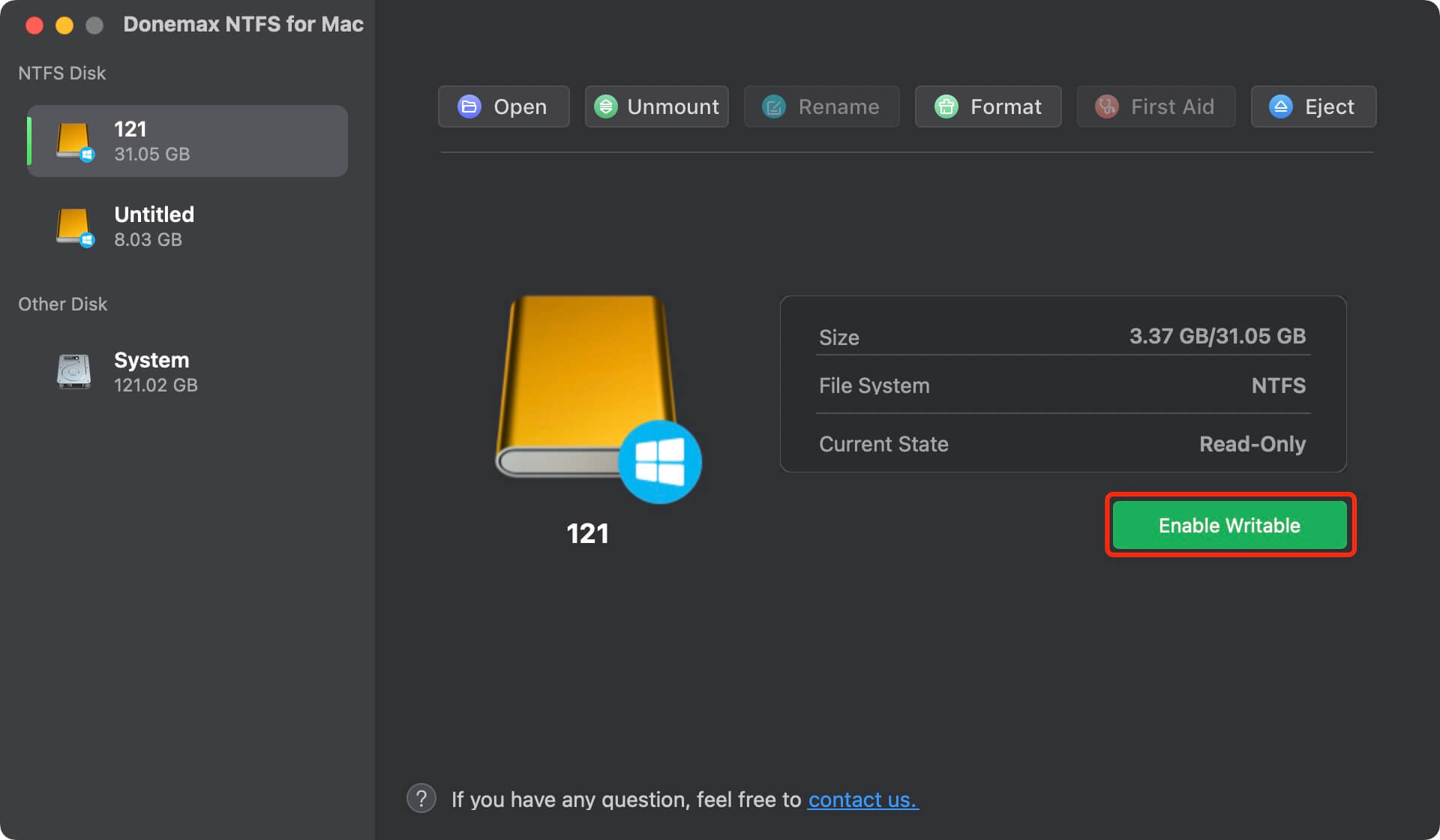
As noted in our exFAT vs FAT32 vs NTFS comparison, macOS natively restricts NTFS drives to Read-Only mode. If you try to drag files onto an NTFS drive on Mac, you will see a greyed-out cursor or permission error.
Rather than spending hours copying files off the drive and reformatting it to exFAT, you can install Donemax NTFS for Mac. It grants instant, full Read-Write access to all NTFS-formatted external drives on your Mac. Just one-click to make the NTFS drive writable on Mac.
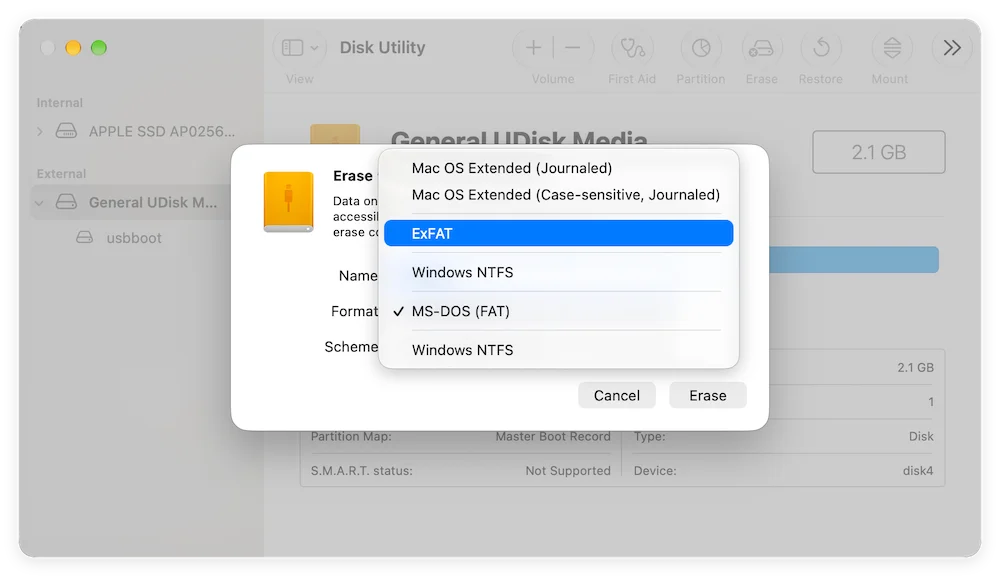
If you decide to reformat your external hard drive, SSD, or USB drive on a Mac, follow these simple steps using Disk Utility:
⚠️ Important Warning: Formatting erases all data on the target drive. Back up your files before proceeding!
Step 1: Connect your external hard drive or USB flash drive to your Mac.
Step 2: Press Command + Spacebar, type 'Disk Utility', and press Enter.
Step 3: Click the 'View' dropdown menu at the top left of Disk Utility and choose 'Show All Devices'.
Step 4: Select your external drive from the left sidebar and click the 'Erase' button on the top toolbar.
Step 5: Name your drive, select 'exFAT' or 'MS-DOS (FAT32)' in the Format dropdown, and set Scheme to 'GUID Partition Map'.
Step 6: Click 'Erase' to complete the formatting process.
Understanding the differences between exFAT vs FAT32 vs NTFS makes it easy to choose the right file system for your hard drive on Mac.
For universal, seamless cross-platform sharing without file size limits, exFAT is the clear winner. If you need to connect an existing NTFS Windows drive to your Mac without formatting, Donemax NTFS for Mac gives you instant, 100% safe read-write access.
Lucien
Lucien is a writer and a chief programmer of Donemax software who has worked in the company for 5+ years. He has written much of the content on the site and devotes to providing troubleshooting and solution for Windows and Mac users including disk cloning, data recovery, migration, eraser, error fixes.
Gerhard Chou
In order to effectively solve the problems for our customers, every article and troubleshooting solution published on our website has been strictly tested and practiced. Our editors love researching and using computers and testing software, and are willing to help computer users with their problems
Clone hard drive with advanced clone technology or create bootable clone for Windows/Mac OS.
Completely and easily recover deleted, formatted, hidden or lost files from hard drive and external storage device.
Certified data erasure software - permanently erase data before selling or donating your disk or any digital device.